
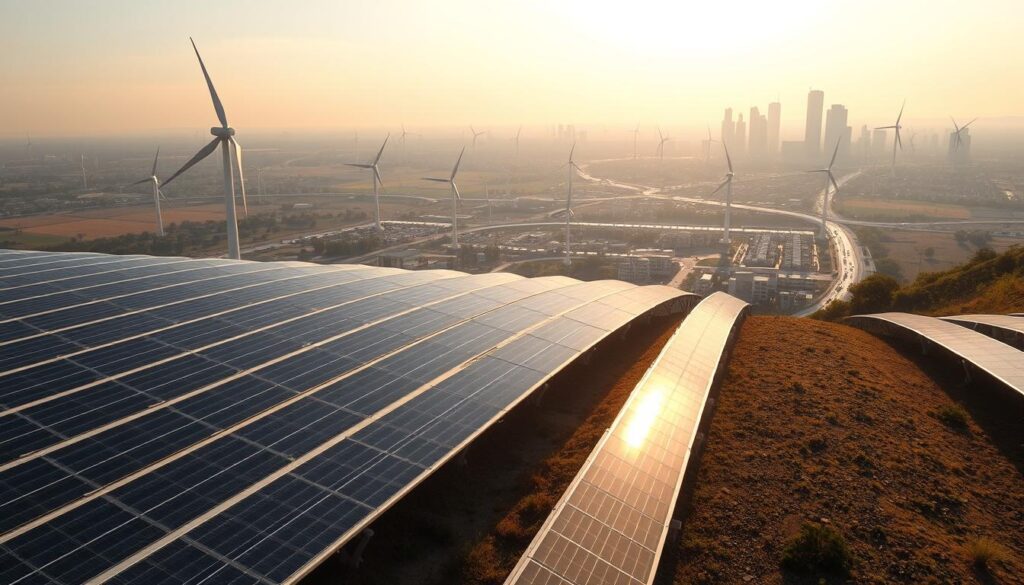
We are facing a big problem with climate change. We need new ways to make our planet better. Artificial intelligence is helping us a lot. It lets us see when bad weather will happen, use less energy, and make our places safer.
We are using AI for climate action to find better ways to solve these problems. With artificial intelligence and sustainability, we can change how we fight climate change.
Key Takeaways
- AI is being used to predict extreme weather events and optimize energy consumption.
- Artificial intelligence is making our places safer and helping the planet.
- AI for climate action is helping us find quick and big solutions.
- Renewable energy optimization is a big area where AI is making a difference.
- AI climate models help us understand and fight climate change better.
The Transformative Power of AI in Climate Action
AI is helping a lot with climate change. It’s finding new ways to fight it. This is very important.
Climate Change as a Complex Data Challenge
Climate change has a lot of data. This data comes from weather, oceans, and more. AI helps make sense of it all.
AI looks at satellite pictures to see where forests are being cut down. It also tracks how much carbon is in the air. This helps us know how to stop climate change better.
Key Applications of AI in Climate Change:
- Predictive modeling for climate forecasting
- Monitoring environmental changes through satellite data
- Optimizing renewable energy sources
How Machine Learning Revolutionizes Environmental Solutions
Machine learning is a part of AI. It helps us understand big data better. This is changing how we fight climate change.
| Application | Description | Impact |
|---|---|---|
| Carbon Capture | AI optimizes carbon capture technologies | Reduces greenhouse gas emissions |
| Disaster Prediction | Machine learning models predict natural disasters | Saves lives and reduces damage |
| Environmental Monitoring | AI-powered systems monitor environmental health | Enables early intervention |
With machine learning and AI, we can fight climate change better. We can make our planet more sustainable.
AI and Climate Change2025: Emerging Technologies and Applications
Looking ahead to 2025, AI is key in fighting climate change. It’s changing how we tackle environmental issues. AI gives us smart tools for studying, predicting, and acting on these problems.
Advanced Predictive Climate Modeling
AI is making big leaps in climate modeling. It looks at huge amounts of data to guess climate patterns better. AI climate models help us see what the future might hold. This lets leaders and scientists plan better.
AI-Powered Disaster Forecasting and Prevention
AI is also helping with disaster forecasting. It looks at old data and current weather to guess when disasters might happen. This helps us warn people early, saving lives and money.
- Enhanced predictive accuracy for natural disasters
- Real-time data analysis for timely warnings
- Integration with emergency response systems
Environmental Monitoring and Emissions Tracking
AI is also key in tracking the environment and emissions. Satellites and IoT devices with AI watch over our planet. They track emissions and find illegal activities like deforestation.
This info is key for keeping countries and companies in check. It helps us find ways to cut down on pollution.
With these new techs, we can fight climate change faster. We’re working towards a greener future for everyone.
Revolutionizing Energy Systems Through Artificial Intelligence

AI is changing energy systems for the better. It helps make grids smarter and cuts down on carbon emissions. As we face climate change, AI is key in managing energy better.
Smart Grid Optimization and Renewable Integration
AI is making smart grids work better with renewable energy. It uses smart analytics to predict energy needs and adjust supply. This keeps the grid stable. Renewable energy optimization is improved by knowing how much solar and wind power will produce.
AI looks at past data and weather to guess energy output. This helps grid managers plan better. It means less use of fossil fuels and less carbon emissions.
| AI Application | Benefit |
|---|---|
| Predictive Analytics | Enhanced grid stability |
| Renewable Energy Forecasting | Increased renewable energy integration |
| Real-time Monitoring | Improved energy efficiency |
Energy Efficiency in Data Centers and Infrastructure
Data centers use a lot of energy, but AI is helping. Google uses AI to save energy in its data centers. It’s made a big difference.
“AI can analyze data from various sensors and make adjustments to optimize energy use, such as adjusting cooling systems or shifting computing tasks to times when energy is cheaper or more available.”
A recent article on Technology Review talks about AI’s role in data center energy. It’s very important as we need more data processing.
AI-Driven Decarbonization Strategies
AI is helping make energy use better across many areas. It finds ways to cut down on carbon emissions. This includes better supply chains and new materials.
- AI-driven predictive maintenance can reduce energy waste in industrial processes.
- Smart energy management systems can optimize energy use in buildings.
- AI can help develop new sustainable materials and technologies.
Using AI for decarbonization helps us move to a greener energy future. It reduces our need for fossil fuels and fights climate change.
AI Applications Across Climate-Critical Sectors

AI is helping in many areas like farming and city planning. It makes things more sustainable and less harmful to the environment. We’re getting better at using AI in important sectors.
Sustainable Agriculture and Food Security
AI is changing farming by making crops grow better and wasting less. Precision agriculture uses AI and IoT to help farmers. They can use data to improve how they water, use fertilizer, and fight pests.
AI can look at satellite pictures to find problems with crops early. This helps farmers fix issues fast.
A report says the precision agriculture market will grow a lot. This is because of AI and machine learning. It’s good for feeding the world and being kind to the planet.
Smart Cities and Eco-Friendly Urban Planning
AI is making cities better and greener. It looks at city data to improve energy use, traffic, and waste. For example, AI can make traffic signals work better to cut down on pollution.
AI also helps in planning cities. It looks at how many people live there, the weather, and what buildings need. This helps cities use less carbon and be ready for climate change. A recent article on AI in climate says this is key for a sustainable future.
Carbon Capture and Natural Resource Management
AI is helping with capturing carbon and managing resources. It makes chemical processes better and finds new materials. This helps make carbon capture systems more efficient.
| Application | Description | Impact |
|---|---|---|
| Optimized Carbon Capture | AI algorithms improve chemical processes for capturing CO2 | Reduced emissions from industrial sources |
| Resource Management | AI analyzes data to predict and prevent over-extraction of resources | Sustainable use of natural resources |
| Eco-Friendly Urban Planning | AI assists in designing cities with green spaces and efficient infrastructure | Enhanced biodiversity and reduced urban heat island effect |
Using AI in these areas can make a big difference. It helps us create a better future. As AI gets better, it will help us more in fighting climate change. This shows why we need to keep improving and investing in AI.
Conclusion: Balancing Innovation with Ethics in AI Climate Solutions
We must balance AI’s power for climate action with ethics. AI helps us adapt to climate change and fight for justice. We need to think about the environment when using AI.
By focusing on AI’s ethics, we make sure it’s used right. We use AI to model climate policies and keep its decisions open. This way, AI helps us without harming the planet.
To learn more about AI’s ethics, check out Merkle’s article on AI and Ethics. Together, we can make a better future. A future where AI helps us without hurting the Earth.
FAQ
How is AI being used to drive sustainability and global action against climate change?
AI helps us understand complex climate data. It also improves energy systems and predicts disasters. This drives us towards a sustainable future and global action against climate change.
What role does machine learning play in revolutionizing environmental solutions?
Machine learning analyzes big data and finds patterns. It helps us create better environmental solutions. This way, we can fight climate change more effectively.
How is AI being used in advanced predictive climate modeling?
AI helps us make more accurate climate models. These models let us understand and predict climate changes. This information helps us make better climate policies.
What are some examples of AI-powered disaster forecasting and prevention?
AI looks at weather, soil, and infrastructure data. It helps predict and prevent disasters like floods and wildfires. This keeps us safe from climate-related dangers.
How is AI being used to optimize energy systems and promote decarbonization?
AI makes energy grids more efficient. It predicts energy needs and finds ways to save energy. This reduces harmful emissions and helps us go green.
What are some examples of AI applications in climate-critical sectors, such as agriculture and urban planning?
AI helps farmers grow crops better and sustainably. It also helps design eco-friendly cities. This makes our food systems and cities more resilient.
How can AI be used responsibly and effectively in addressing climate change?
AI must be transparent and fair. It should help everyone equally. This ensures climate justice and a sustainable future.
What are some of the challenges associated with using AI in climate action?
Challenges include good data and fairness in AI. We also need to make AI decisions clear. This ensures AI helps us in a fair way.
How can AI support net-zero goals and climate resilience?
AI optimizes energy and predicts disasters. It also helps with sustainable land use. This supports our goals for a zero-carbon future and resilience.
What is the role of AI in climate policy modeling and enforcement?
AI analyzes policy scenarios and predicts outcomes. It also checks if rules are followed. This helps us make better climate policies.